Site Translator

Showing posts with label Soul Forge. Show all posts

Friday, July 19, 2013

The Pain Box


The tarantula hawk wasp


A cool story with an important lesson.

In the "yin" and "yang" of things,  arrogance and fear are just parts of the same equation. The wisdom is to recognize where your head is at exactly.

Click HERE


Sunday, December 30, 2012


If people bring so much courage to this world the world has to kill them to break them, so of course it kills them. The world breaks everyone and afterward many are strong in the broken places. But those that will not break it kills. It kills the very good and the very gentle and the very brave impartially. If you are none of these you can be sure it will kill you too but there will be no special hurry.

- Ernest Hemingway
  A Farewell to Arms

Wednesday, September 28, 2011

Charlie Chaplin Movie Speech


From the 1940 film The Great Dictator written, directed and starred in by the legendary American actor himself.


Thursday, August 18, 2011

Sunscreen

Remember this? Some things I can't relate with, but overall, encouraging bits of wisdom.


Wednesday, March 23, 2011

Black Hawk Down


I first watched this movie a decade ago and I distinctly remember the profound effect it had on me. 

So many fascinating elements behind it; the background behind the unrest  and conflict in Mogadishu, the  tense but moving field trauma scene where the medic was trying to save his team mate (trying to mend the femoral artery). It also highlighted the heroism of the snipers Randy Shugart and Gary Gordon and how their selfless actions were awarded by being bestowed the US Medal of Honor posthumously.  

When everything is said and done, there is only  one  reason as to why a dedicated soldier fights. I'll let "Hoot", probably the movie's most recognizable character,  tell it in the plainest way possible - 


Lastly, the glorious theme also at the end is from the old, traditional Irish folk tune called "The Minstrel Boy". The melancholy of the bagpipes is something I've always liked as well. It really is fitting to be put in this film. 


Saturday, December 25, 2010

The Men That Don't Fit In


I've been an outsider most of my life. I always felt I didn't fit in with the crowd. I've made peace with the fact that I often have to go at it alone. Its not an easy way I admit, but that's just me.

I've also been the restless kind. Maybe its because I've never been good with the "what you're supposed to do" idea as with most people ("you're supposed to be like the rest, get married, get a good job, be rich and successful, etc, etc, and so forth"). I suppose I'm looking for my own little niche somewhere. I'm glad though that there are also other restless guys out there like me.

One such guy is the American poet and writer Robert W. Service. He felt he didn't fit in too and wrote some good words about guys like us. 

To the "restless" and "outsiders". . .


The Men That Don't Fit In
by Robert Service

There's a race of men that don't fit in,
A race that can't stay still;
So they break the hearts of kith and kin,
And they roam the world at will.
They range the field and they rove the flood,
And they climb the mountain's crest;
Theirs is the curse of the gypsy blood,
And they don't know how to rest.

If they just went straight they might go far;
They are strong and brave and true;
But they're always tired of the things that are,
And they want the strange and new.
They say: "Could I find my proper groove,
What a deep mark I would make!"
So they chop and change, and each fresh move
Is only a fresh mistake.

And each forgets, as he strips and runs
With a brilliant, fitful pace,
It's the steady, quiet, plodding ones
Who win in the lifelong race.
And each forgets that his youth has fled,
Forgets that his prime is past,
Till he stands one day, with a hope that's dead,
In the glare of the truth at last.


Monday, December 13, 2010

50th Anniversary of "To Kill A Mockingbird"


Scout and Atticus Finch from the movie

I just found out about this in the opinion column of Ramon J. Farolan (REVEILLE/We-could-use-a-Truth-Commission) from yesterday's copy of the Inquirer which was an excellent read BTW.

I admit I've never read the book considered as one of the greatest American classics delving into the themes of racism and justice, but I have seen the film many years ago. It deserves recognition as well (it won an Oscar for the brilliance of Gregory Peck in the lead role). It is told from the eyes of a precocious 6-year old, "Scout" and of how her courageous father, lawyer "Atticus Finch", was faced with having to defend a "negro" accused of raping a white woman. One has to consider the setting for all of this which was in the 1930's in a southern state of America. It was a bad time in a bad place to be a black man as mob lynchings was common. It was author Harper Lee's first and only book.

I found a Youtube vid with the powerful words of Finch's defense in the movie. It centers on the citizen's final refuge, the court of law, where justice supposedly resides and where we all are equal regardless of what we are.


Wednesday, December 1, 2010

He Who Held the Bolo


Andres Bonifacio

I had planned on writing something earlier about the man known as "The Great Plebian" as we just celebrated the day honoring him (November 30th) but life got in the way. We either see images or actually get to pass by some statues of him frequently, frozen in a mythical stance of defiance, with pistol and unsheathed menacing itak (bolo) in either hand. But he was more than just a stone figure.  

We do have the great Jose Rizal of international renown as our national hero. If I had my way though, I think there's room enough for both of them to occupy such an honor. Looking at it from various points, he was nothing like Rizal. He wasn't born of privilege or landed wealth. He didn't receive higher education and learn from universities or converse with foreign intellectuals. He was born of humble stock and led a life that was marked by struggle and simplicity. Orphaned at an early age and being the eldest, he took it upon himself to give up school and support his siblings' studies by working and selling wooden canes and paper fans part time in the streets.

He had this silent fire burning deep down inside him. This is what enabled him not to to merely accept his "humble" stature in life and make something of himself. He never stopped reading and learning and had even amassed a collection of books including the Bible, Les Miserables, Religion Within the Reach of All, The History of the French Revolution, International Law, Civil Code, Penal Code, Lives of the Presidents of the United States among others. He would have had an understanding of Spanish, French and English, no mere feats for someone who only got the equivalent of the fourth grade.   

Most of all though, Filipino history remembers him as the founder, the "Supremo", of the Katipunan, the   revolutionary organization that spear-headed the resistance and struggle that ultimately won our freedom from the colonial oppression of Spain. While the rich and learned would've accepted being a vassal to Spain so long as their property and way of life would continue, that fire burning deep down Gat Andres inspired other "poor" men and women like him to unite and rise up, despite all the odds. He enabled them to dream something so fundamental in all of us that it was worth the great struggle and even certain death: freedom. Anyone who can inspire such a thing in people and work to attain it should certainly be held up high and be remembered. Again, no small feat for a mere "plebe".   

He was able to put into words this dream of freedom that grew out of a deep love for the homeland. It was a beautiful poem that stirs something inside the soul that makes us both proud and humbled as this nation's sons and daughters.  

He was and still is, the closest hero every common Filipino in this "poor" country of ours could look up to.


Maraming salamat po, Gat Andres Bonifacio!


Pagibig sa Tinubuang Bayan

Aling pag-ibig pa ang hihigit kaya
Sa pagkadalisay at pagkadakila
Gaya ng pag-ibig sa Tinubuang lupa?
Aling pag-ibig pa? Wala na nga, wala.

Pagpupuring lubos ang palaging hangad
Sa bayan ng taong may dangal na ingat,
Umawit, tumula, kumanta't sumulat,
Kalakhan din niya'y isinisiwalat.

Walang mahalagang hindi inihandog
Ng may pusong mahal sa Bayang nagkupkop,
Dugo, yaman, dunong, katiisa't pagod,
Buhay ma'y abuting magkalagut-lagot.

Bakit? Alin ito na sakdal ng laki,
Na hinahandugan ng busong pagkasi,
Na sa lalong mahal nakapangyayari,
At ginugulan ng buhay na iwi?

Ay! Ito'y ang Inang Bayang tinubuan:
Siya'y ina't tangi sa kinamulatan
Ng kawili-wiling liwanang ng araw
Na nagbigay-init sa buong katawan.

Kalakip din nito'y pag-ibig sa Bayan,
Ang lahat ng lalong sa gunita'y mahal,
Mula sa masaya'y gasong kasanggulan
Hanggang sa katawa'y mapasa-libingan.

Sa aba ng abang mawalay sa bayan!
Gunita ma'y laging sakbibi ng lumbay,
Walang alaala't inaasa-asam
Kundi ang makita'y lupang tinubuan.

Pati ng magdusa'y sampung kamatayan
Wari ay masarap kung dahil sa bayan
At lalong mahirap. Oh, himalang bagay!
Lalong pag-irog pa ang sa kanya'y alay.

Kung ang bayang ito'y masasa-panganib
At siya ay dapat na ipagtangkilik,
Ang anak, asawa, magulang, kapatid;
Isang tawag niya'y tatalikdang pilit.

Hayo na nga, hayo, kayong nagabuhay
Sa pag-asang lubos ng kaginhawahan
At walang tinamo kundi kapaitan,
Hayo na't ibangon ang naabang bayan!

Kayong nalagasan ng bunga't bulaklak
Ng kahoy ng buhay na nilanta't sukat,
Ng bala-balaki't makapal na hirap,
Muling manariwa't sa baya'y lumiyag.

Ipahandug-handog ang busong pag-ibig
At hanggang may dugo'y ubusing itigis;
kung sa pagtatanggol, buhay ay mapatid,
Ito'y kapalaran at tunay na langit!

The English translation as taken from this site: http://kasaysayan-kkk.info/docs.ab.pagibig.htm

Love of Country

What love can be
purer and greater
than love of country?
What love? No other love, none.


Even when the mind repeatedly reads
and try to understand
the history that is written and printed
by humanity, this (love of country) can be seen.

Holy love! When born
of a pure heart,
the humble and the backwoodsman, the poor, the unlettered
become great and respected.

Love of country
is always the desire of a man with honor;
In songs, in poetry, in his writings
the greatness of the country is always the theme.

Nothing dear to a person with a pure heart
is denied to the country that gave him birth:
blood, wealth, knowledge, sacrifices,
E'en if life itself ends.

Why? what is this that is so big
to which is dedicated with utmost devotion,
all that is dear
and to which life is sacrificed.

Ah, this is the Mother country of one's birth,
she is the mother on whom
the soft rays of the sun shine,
which gives strength to the weak body.

To her one owes the first kiss
of the wind that is the balm
of the oppressed heart drowning
in the deep well of misfortune and suffering.

Entwined with this is love of country,
everything that is dear to the memory,
from the happy and careless childhood
to the hour of death.

The bygone days of joy,
the future that is hoped
will free the slaves,
where can this be found but in one's native land?

Every tree and branch
of her fields and forest joyful to behold,
'tis enough to see them to remember
the mother, the loved one, and the happiness now gone.

Her clear waters --
they come from the mountain springs,
the soft whisper of the rushing wavelets
enlivens the sorrowing heart.

How unfortunate to be separated from the country!
Even memory is in sorrow's embrace,
nothing is desired
but to see the country of one's birth.

If this country is in danger
and she needs defending,
Forsaken are the children,
the wife, the parents, the brothers and sisters
at the country's beck and call.

And if our land, Filipinas,
is offended and her honor, reason, and dignity outraged,
by a traitorous foreign country;

What unhappiness and grief
will invade the heart of the Filipino?
And will not even the most peaceful
Rise to avenge her honor?

Where will the strength
to take revenge and to throw away life come,
if none can be relied upon for help,
but those suffering from slavery?

If his suffering and slavery
are in the mire of deceit and oppression,
one holds the whip, the chains that bind,
and only tears are allowed to roll down.

Who is there to whom her condition
Will not fill the soul with sorrow?
Will the heart most hardened by treachery
Not be moved to give her its life blood?

Will not, perchance, her sorrow
Drive the Filipinos to come to the rescue
of the mother in agony, trampled
underfoot by the mean Spaniards?

Where is the honor of the Filipino?
Where is the blood that should be shed?
The country is being oppressed, why not make a move,
you are shocked witnessing this.

Go, you who have lived
in the full hope of comfort,
and who reaped nothing but bitterness,
Go and love the oppressed country.

You who, from the stream of your breast,
have lost the holy desire to sacrifice,
Once more let true love flow,
express that love for the imprisoned country.

You from whom the fruit and flowers
of your life have been plucked
by intrigues and incomparable sufferings,
once more freshen up and love thy country.

You, so many hearts that... ?
of cheating and oppression of the mean in actions,
now rise up and save the country,
snatch it from the claws of the tyrant.

You who are poor without... ?
except to live in poverty and suffering,
protect the country if your desire is to end
your sufferings, for her progress is for all.

Dedicate with all your love --
as long there is blood -- shed every drop of it,
If for the defense of the country life is... ?
this is fate and true glory.

The moving song that put to life the equally moving words from the poem -

Friday, November 5, 2010

The Kartilya of the Katipunan


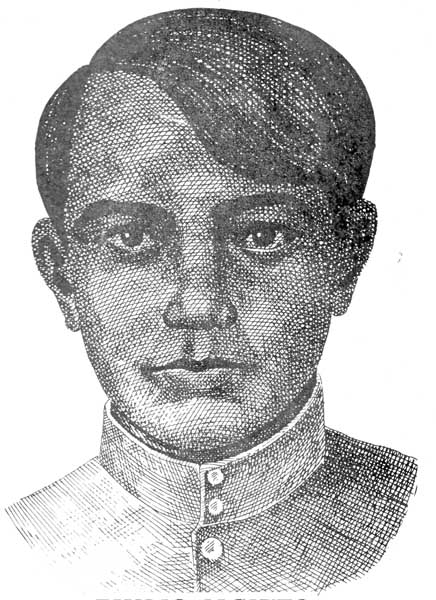
Emilio Jacinto
Author of the Kartilya ng Katipunan


The flag the Katipunan adopted in 1897

The Katipunan or short for Kataastaasang, Kagalanggalang, Katipunan ng mga Anak ng Bayan (“Highest, Most-Honorable Assembly of the Sons of the Nation” or simply the Supreme Assembly) was the revolutionary society founded in the late 19th century that aimed to overthrow Spanish rule over the Philippines. Some of its members later became heroes of this nation. They were united in their longing for an independent Philippines free from the yoke of colonization and oppression.

Kartilya derives form the Spanish for a primer for pupils in school. It was created as a guidebook for the new members of the Katipunan to present them with the principles it stood for. The first edition was created by Emilio Jacinto who was known as the “Utak ng Katipunan” (Brains of the Katipunan) for his guiding intellect in their efforts.

If solely on the context by which it is considered, a primer for indoctrinating new recruits into a resistance movement, it seems similar with the higher martial ideals of Japanese Bushido (Way of the Warrior) or the code of chivalry of the medieval European knights.

Then again the lofty words and gentle admonitions counseling one to conduct himself to a more noble way of life seems very much akin to the tone of the Chinese philosopher and moralist Confucius.

Or it might simply be the words one passes to his fellowman as his way of strengthening the love for one’s country.

Its message though is eternal and provides direction even today. Below is the script for the Kartilya in its original Tagalog language coupled with its English translation taken from this site:


http://en.wikipilipinas.org/index.php?title=Kartilya_ng_Katipunan

1. Ang buhay na hindi ginugugol sa isang malaki at banal na kadahilanan ay kahoy(puno) na walang lilim, kundi (man) damong makamandag.

A life that is not dedicated to a noble cause is like a tree without a shade or a poisonous weed.

2. Ang gawang magaling na nagbubuhat sa paghahambog o papipita sa sarili (paghahangad na makasarili), at hindi talagang nasang gumawa ng kagalingan, ay di kabaitan.

A deed lacks nobility if it is motivated by self-interest and not by a sincere desire to help.

3. Ang tunay na kabanalan ay ang pagkakawang-gawa, ang pag-ibig sa kapwa at ang isukat ang bawat kilos, gawa't pangungusap sa talagang Katuwiran.

True piety consists of being charitable, loving one’s fellow men, and being judicious in behavior, speech and deed.

4. Maitim man o maputi ang kulay ng balat, lahat ng tao'y magkakapantay; mangyayaring ang isa'y hihigitan sa dunong, sa yaman, sa ganda; ngunit di mahihigitan sa pagkatao.

All persons are equal, regardless of the color of their skin. While one could have more schooling, wealth, or beauty than another, all that does not make one more human than anybody else.

5. Ang may mataas na kalooban, inuuna ang (dangal o) puri kaysa pagpipita sa sarili; ang may hamak na kalooban, inuuna ang pagpipita sa sarili sa puri.

A person with a noble character values honor above self-interest, while a person with a base character values self-interest above honor.

6. Sa taong may hiya, salita'y panunumpa.

To a person of honor, his/her word is a pledge.

7. Huwag mong sayangin ang panahon; ang yamang nawala'y mangyayaring magbalik; ngunit panahong nagdaan nay di na muli pang magdadaan.

Don’t waste time; lost wealth can be retrieved, but time lost is lost forever.

8. Ipagtanggol mo ang inaapi;kabakahin (labanan) ang umaapi.

Defend the oppressed and fight the oppressor.

9. Ang taong matalino'y ang may pag-iingat sa bawat sasabihin;matutong ipaglihim ang dapat ipaglihim.

The wise person is careful in all he/she has to say and is discreet about things that need to be kept secret.

10. Sa daang matinik ng buhay, lalaki ang siyang patnugot ng asawa at mga anak; kung ang umaakay ay tungo sa sama, patutunguhan ng inaakay ay kasamaan din. (Ang simula nito ay obserbasyon sa ugnayan ng babae at lalaki sa panahon ng Katipunan; para sa kasalukuyan, iminumungkahing ipalit ang sumusunod: "Sa daang matinik ng buhay, ang mga magulang ang patnugot ng mag-anak; kung ang umaakay ay tungo sa sama, and patutunguhan ng inaakay ay kasamaan din.)

On the thorny path of life, the man leads the way and his wife and children follow. If the leader goes the way to perdition, so do the followers. (Note: This begins with an observation of the vertical relationship of husband and wife during the time of the Katipunan; now, we can say that the parents lead the way and the children follow.)

11. Ang babae ay huwag mong tingnang isang bagay na libangan lamang, kundi isnag katuwang at karamay (ng lalaki) sa mga kahirapan nitong buhay; gamitin mo nang buong pagpipitagan ang kanyang (pisikal na ) kahinaan, alalahanin ang inang pinagbuhatan at nag-iwi sa iyong kasanggulan.

Never regard a woman as an object for you to trifle with; rather you should consider her as a partner and helpmate. Give proper consideration to a woman’s frailty and never forget that your own mother, who brought you forth and nurtured you from infancy, is herself such a person.

12. Ang di mo ibig gawin sa asawa mo, anak at kapatid, ay huwag mong gagawin sa asawa, anak at kapatid ng iba.

Don’t do to the wife, children, brothers, and sisters of others what you do not want done to your wife, children, brothers, and sisters.

13. Ang kamahalan ng tao'y wala sa pagkahari, wala sa tangos ng ilong at puti ng mukha, wala sa pagkaparing kahalili ng Diyos, wala sa mataas na kalagayan sa balat ng lupa: wagas at tunay na mahal na tao, kahit laking gubat at walang nababatid kundi sariling wika, yaong may magandang asal, may isang pangungusap, may dangal at puri, yaong di nagpaaapi't di nakikiapi; yaong marunong magdam-dam at marunong lumingap sa bayang tinubuan.

A man’s worth is not measured by his station in life, neither by the height of his nose nor the fairness of skin, and certainly not by whether he is a priest claiming to be God’s deputy. Even if he a tribesman from the hills and speaks only his tongue, a man has fine perceptions and is loyal to his native land.

14. Paglaganap ng mga aral na ito, at maningning na sisikat ang araw ng mahal na kalayaan dito sa kaaba-abang Sangkapuluan at sabungan ng matamis niyang liwanag ang nangagkaisang magkakalahi't magkakapatid, ng liwanag ng walang katapusan, ang mga ginugol na buhay, pagod, at mga tiniis na kahirapa'y labis nang matutumbasan.

When these teachings shall have been propagated and the glorious sun of freedom begins to shine on these poor Islands to enlighten a united race and people, then all the lives lost, all the struggle and the sacrifices will not have been in vain.